
Ready to Get Started?
Send us information on you, your company and your project. One of our experts will respond as soon as possible.

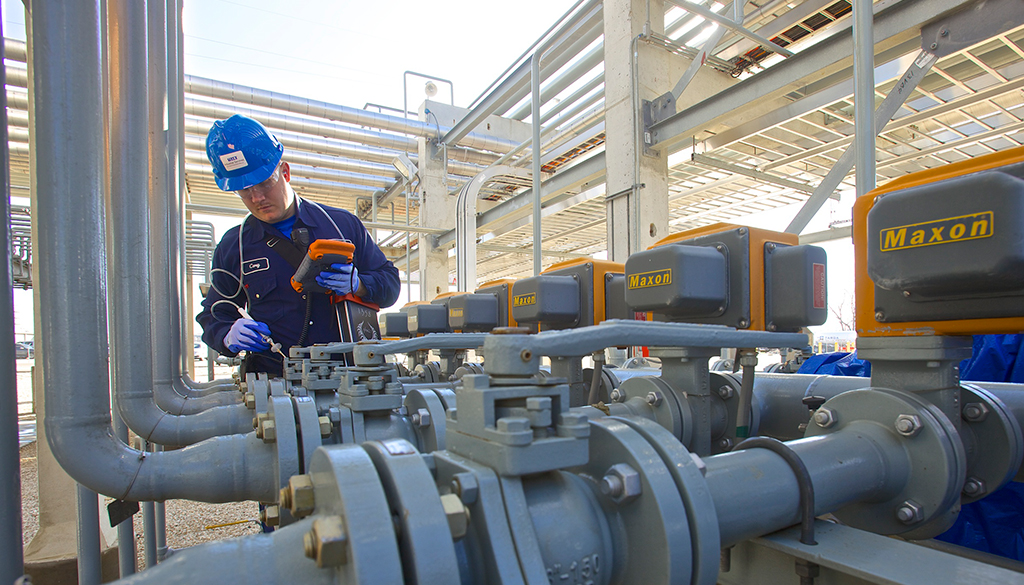
Across refineries, chemical plants, and natural gas facilities, fugitive emissions are an inescapable operational reality. Valves wear, seals degrade, and flanges loosen under thermal cycling, leaving gaps that are invisible to the naked eye but very visible on a regulatory report. When process fluids contact those weakened points, volatile organic compounds (VOCs) and hazardous air pollutants (HAPs) escape continuously, and in volumes that compound quickly.
The EPA estimates that equipment leaks release approximately 70,000 tons of VOCs and nearly 10,000 tons of HAPs into the atmosphere annually across U.S. industrial facilities. Valves alone account for roughly 60% of that total, making them the single largest source of fugitive emissions at most facilities.
For operators, the consequences are real and compounding: product loss that quietly erodes margin, compliance exposure that surfaces at the worst possible time, and the mounting cost of managing a fragmented program across multiple contractors with no single source of truth.
A Leak Detection and Repair (LDAR) program is the structured, regulatory-mandated answer to fugitive emissions. While most facilities have an LDAR program on paper, when its time to be audited, the cracks are immediately exposed. Creating and implementing a truly effective LDAR
Before a single technician sets foot on the unit and before a single component is tagged, two foundational questions must first be answered: what rules apply, and what exactly needs to be monitored?
A regulatory applicability assessment determines which federal and state standards govern a facility and creates the guardrails for building an effective LDAR program. Depending on when it was built, what it processes, and where it operates, the answer could be NSPS Subpart VVa for a petroleum refinery, Subpart OOOOb for an oil and gas operation, NESHAP requirements under 40 CFR Part 63, or a layered combination of all three.
When organizations apply the wrong standard to a process unit, the program is built on a flawed premise. Even though you’re putting in the legwork to do your due diligence, your efforts have already created a compliance gap before a single inspection cycle is ever completed.
After applicable regulations are established, its time to build out your component inventory. Every valve, pump seal, flange, connector, pressure relief device, and open-ended line in VOC or HAP service needs to be identified, tagged, and connected to its governing requirement. It’s a process that requires walking the facility, verifying P&IDs against what’s actually installed in the field, and reconciling the gap between what the drawings say and what reality looks like after years of modifications, turnarounds, and equipment changes.
The EPA’s LDAR Best Practices Guide identifies failure to maintain accurate, current P&IDs as one of the most frequently cited issues during enforcement inspections. This stage is so critical to an LDAR strategy’s overall effectiveness because miscalculating inventory leads to incorrect inspection routes, leaving leaking components unmonitored.
Every equipment modification, new process unit, or piece of replaced hardware represents a potential change to the regulated population. A Management of Change (MOC) process keeps the inventory from quietly drifting out of alignment with the actual facility over time.
TEAM performs regulatory and stream-applicability assessments and builds component inventories grounded in actual field conditions. A program is only as strong as the foundation it’s built on, and assumptions often become violations.
With the inventory established, the next question is how and how often to inspect. EPA regulations recognize two primary detection methods. Method 21 uses portable organic vapor analyzers: technicians place a probe at each component interface and record readings against the applicable leak threshold, typically somewhere between 500 and 10,000 ppm, depending on the governing standard. Optical Gas Imaging (OGI) uses high-sensitivity infrared cameras to visualize gas plumes that are otherwise invisible to the naked eye, allowing crews to scan wide areas and large component populations from a safe distance without shutdowns, contact measurements, or taking systems offline.
LDAR effectiveness ranges from 30% to 97%, depending on inspection frequency, leak threshold, and repair requirements, pointing to the difference between a program that catches leaks and one that falls short. TEAM’s Detect360 crews are trained and certified in both Method 21 and OGI, including Quantitative OGI (QOGI), which provides real-time, GPS-tagged leak-rate quantification directly in the field. Every program is structured around the applicable regulatory schedule, with centralized routing and data management built in from the start, so nothing falls through the cracks between inspection cycles.
Under the EPA’s final methane rule, repairs must begin within 30 days of detection and be completed within 30 days after that. Other standards are more demanding, with some requiring a first repair attempt within as little as 5 days. Miss those windows and the leak itself, and the leak becomes a violation.
Then, a follow-up inspection is required to confirm that the fix is held. If it didn’t, another repair is required within 15 calendar days. Regulators look for timely and documented cycles of detect, repair, verify, and repeat when they review a program.
When a component genuinely can’t be repaired immediately because it requires a process shutdown, or because parts aren’t available, a Delay of Repair (DOR) must be formally documented. DORs are time-bounded, tracked records that regulators will review.
Undocumented delays and blown repair windows are consistently among the first things EPA enforcement teams find, and the easiest violations to avoid with a system that actually tracks
Not all leaks carry the same risk, and the order of repairs should reflect that, with high-emitters and safety-impacting components prioritized first. TEAM’s Detect360 LDAR program connects directly to Repair360 capabilities, which means leaks found during an inspection can often be addressed by the same crew on the same mobilization. Live leak sealing, composite repairs, on-stream valve repair, and hot taps, all without taking systems offline.
Facilities managing LDAR compliance must generate emissions inventories, track leak rates across monitoring periods, maintain repair records with documented completion dates, and file semi-annual compliance reports. Under the EPA’s Greenhouse Gas Reporting Program Subpart W, methane emissions data must be submitted through the e-GGRT platform in a specific format with specific calculations.
Many otherwise functional LDAR programs break down due to manual data collection. TEAM’s reporting infrastructure seamlessly closes this gap. The proprietary M21 Reporter software captures inspection data and technician activity daily, flagging anomalies before they become compliance issues. The LDAR Compliance Assurance Ticket Tracker (L-CATT) reviews every data upload, sending alerts to the LDAR Supervisor and Data Administrator the moment something looks off. Problems surface at the data level, not six months later when a regulator finds them first.
When EPA enforcement teams review an LDAR program, they’re looking at whether instruments were properly calibrated, whether Method 21 procedures were followed, whether the monitoring pace was physically consistent with thorough fugitive emissions monitoring, and whether repair records align with documented timeframes. Incomplete calibration logs, routes completed too fast to be credible, and repair dates that don’t match field records can all unravel otherwise effective programs.
The EPA recommends calibration drift assessments at the end of every monitoring shift, quarterly QA/QC reviews of inspection data, shadow monitoring to verify technician consistency, and periodic field audits to confirm that the LDAR component inventory still reflects what’s installed. Facilities that build internal audits into their regular program cadence are in a measurably stronger position when external scrutiny arrives.
TEAM’s LDAR compliance programs include multi-level technician certification, structured QA/QC review on every engagement, and automated daily monitoring through L-CATT, so that the discipline that protects the program is built in at every stage.
The most effective leak detection and repair programs are integrated into a broader asset integrity strategy where every phase informs the next, and nothing gets lost between handoffs.
Our approach ensures LDAR is executed effectively from every angle. Inspect360 identifies the asset conditions that create leak risks before they become reportable emissions. Detect360 runs the LDAR compliance program and generates the data record. Repair360 resolves leaks without taking systems offline. OneInsight® ties it all together with inspection findings, LDAR repair tracking, and compliance reporting in a single audit-ready platform with full visibility at every stage.
The EPA estimates that well-designed LDAR programs can reduce fugitive emissions at refineries by up to 63% and at chemical plants by up to 56%. Getting there means building a program that prevents nothing from falling through the cracks between contractors, between inspection cycles, or between a leak found and a leak fixed.
That’s the anatomy of a program built to perform.
TEAM Inc. is available 24 hours a day, 7 days a week, 365 days a year to provide the support you need whenever you need it.
Call the Emergency HotlineSend us information on you, your company and your project. One of our experts will respond as soon as possible.