
Ready to Get Started?
Send us information on you, your company and your project. One of our experts will respond as soon as possible.
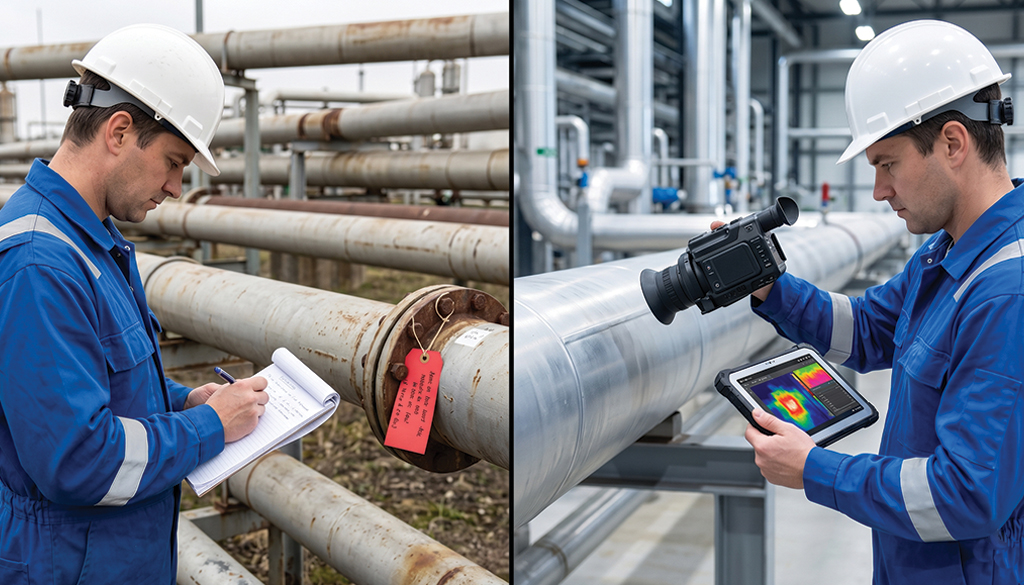
Imagine a refinery technician in 1978 making his rounds with a handheld flame ionization detector (commonly known as the swiffer wand), methodically placing it against each valve, flange, and pump seal on his assigned route. He has hundreds of components to check. The wind is picking up, which means any reading he gets in the next hour is probably unreliable. He’ll document his findings by hand, and those records will live in a filing cabinet until the next scheduled inspection. If there’s a leak he missed, it will keep leaking until he or someone else comes back around.
Now picture what’s possible today: a drone-mounted infrared sensor sweeping a compressor station and visualizing a methane plume in real time, a satellite flagging a super-emitting event from orbit, an OGI camera quantifying not just that a valve is leaking but exactly how much. And digital platforms that connect every finding to a timestamped repair record, accessible to regulators, auditors, and operators from a single dashboard.
The distance between those two pictures is one of the most consequential technological arcs in the history of industrial operations. Here’s how we got here and why it matters more now than ever.
Leak detection, as a formalized practice, was born of regulation. The Clean Air Act of 1955 and its landmark 1990 amendments created the legal framework that eventually required oil, gas, and chemical facilities to implement structured Leak Detection and Repair programs. The EPA’s Method 21, standardized in the 1970s, became the foundation of industrial LDAR for decades. The protocol seemed simple enough: send a technician with a portable FID or PID instrument to physically sniff each component for emissions above a defined threshold, typically 500 parts per million by volume for VOCs.
In practice, it was an incredibly complex process. A medium-sized petroleum refinery might have 250,000 individual components requiring inspection. The work was labor-intensive, tedious, weather-dependent, and prone to measurement error. Even a light crosswind could invalidate a reading. Records were paper-based, hard to audit, and harder to act on quickly. And this approach found only what a technician physically reached, at the moment they happened to be standing there.
The consequences for undetected leaks were staggering. ExxonMobil faced major penalties in the late 1990s and early 2000s after regulators found systemic LDAR failures across multiple facilities. Even the most rigorous Method 21 program was fighting against structural limitations. You can only find what your method is capable of finding, and what a sniffer wand could find was a fraction of what was actually leaking.
The shift began in 2005, when FLIR introduced the GasFindIR, the first commercially available optical gas imaging camera. For the first time in the industry’s history, an inspector could point a device at a piece of equipment and see an invisible gas as a visible plume, rendered in infrared. Instead of touching a probe to each component, one inspector with an optical gas imaging (OGI) camera could survey an entire unit from a distance in a fraction of the time and visualize emissions that Method 21 would never have detected.
Studies have shown that OGI can detect over 80% of emissions at a standoff distance of just 10 meters. The EPA recognized the technology formally and established OGI as the Best System of Emission Reduction for oil and gas facilities, the regulatory stamp of approval that drove industry-wide adoption.
But optical gas imaging has another limitation: it’s qualitative. An infrared camera could show you that something was leaking, but not by how much. In an industry where emissions reporting increasingly requires hard numbers, this was a critical shortfall.
The mid-2010s brought technology that not only answered the question “where are the leaks,” but also “how big are they?” Quantitative OGI (QOGI) integrated emission rate measurement directly into the imaging process, shifting the conversation from observation to data to feed regulatory reporting, informs repair prioritization, and holds up under third-party verification.
At the same time, a structural reality about the distribution of emissions was becoming impossible to ignore. Studies have found that the top 5% of sites account for approximately 50% of fugitive methane emissions. These “super-emitters” represented a disproportionate mitigation opportunity, but only if detection programs were frequent and sufficiently sensitive to detect them.
This sparked the development of the modern LDAR toolkit. TEAM’s Detect360 integrates all steps to identify leaks and emissions comprehensively. OGI surveys that visualize what contact-based methods miss; comprehensive LDAR programs that combine Method 21 compliance with advanced detection protocols; greenhouse gas control that addresses VOC and GHG exposures beyond methane alone; and methane emissions reduction solutions built for both regulatory compliance and operational efficiency. Crucially, all of it is documented through OneInsight®, creating the GPS-tagged, timestamped, audit-ready record that modern emissions reporting demands.
Drone-mounted gas sensors extended detection further still to remote well pads, inaccessible compressor stations, and pipeline segments where sending a ground crew was slow, expensive, or hazardous. What had been a fundamental limitation of the Method 21 era (the difficulty of physically reaching every component) became, at last, a solvable problem.
For all the technology now available to detect emissions, the real measure of an emissions management program is what happens after detection. A leak found and documented but not repaired for sixty days is not solved.
Integrating leak detection into a broader asset integrity program becomes the decisive factor. The IEA’s 2026 Global Methane Tracker estimates that the energy sector can avoid 70% of annual methane emissions with existing technologies. For most operators, the real barrier is closing them efficiently, without shutdowns, without multi-vendor coordination delays, and with documentation that holds up under regulatory scrutiny.
TEAM360’s integrated framework connects every finding directly to Repair360 and OneInsight®. A leak identified in the field moves into a repair workflow without a handoff to a separate vendor, without documentation that lives in a disconnected system, and without the delay that turns a manageable emissions event into an extended exposure.
The contrast with the sniffer wand era is almost architectural. Then, detection and repair were sequential activities owned by different people, often documented on paper, and measured against compliance thresholds rather than actual emissions reduction. Now, the best programs integrate real-time detection, immediate repair mobilization, and continuous data management into a single operational loop.
The arc of emissions detection technology is a story as much about visibility as it is about action. For decades, the tools didn’t exist to find what was leaking, quantify how much was leaking, or close the gap between discovery and repair at the pace that modern emissions standards demand.
Now, they do. And through TEAM360, the most advanced technologies and services are all layered into one seamless program to eliminate vendor handoffs, ensure nothing gets missed, and connect every finding directly to a repair workflow backed by audit-ready documentation. Learn how our TEAM delivers the complete detection-to-repair loop that compliance and operational performance both demand.
TEAM Inc. is available 24 hours a day, 7 days a week, 365 days a year to provide the support you need whenever you need it.
Call the Emergency HotlineSend us information on you, your company and your project. One of our experts will respond as soon as possible.